Budva sits roughly halfway along the Montenegrin coast, which makes it one of the best-connected bases for day trips in the country. The Bay of Kotor is 30 minutes north, Sveti Stefan is 15 minutes south, and the mountain interior — Lovćen, Cetinje, Skadar Lake — is reachable within an hour or two. Montenegro is small enough that you can drive from one end to the other in three hours, so almost anything is within day-trip range.
Here are the trips worth making, with practical details on how to get there and what to expect.
Sveti Stefan
Distance: 6 km south of Budva (15 minutes by car or local bus)
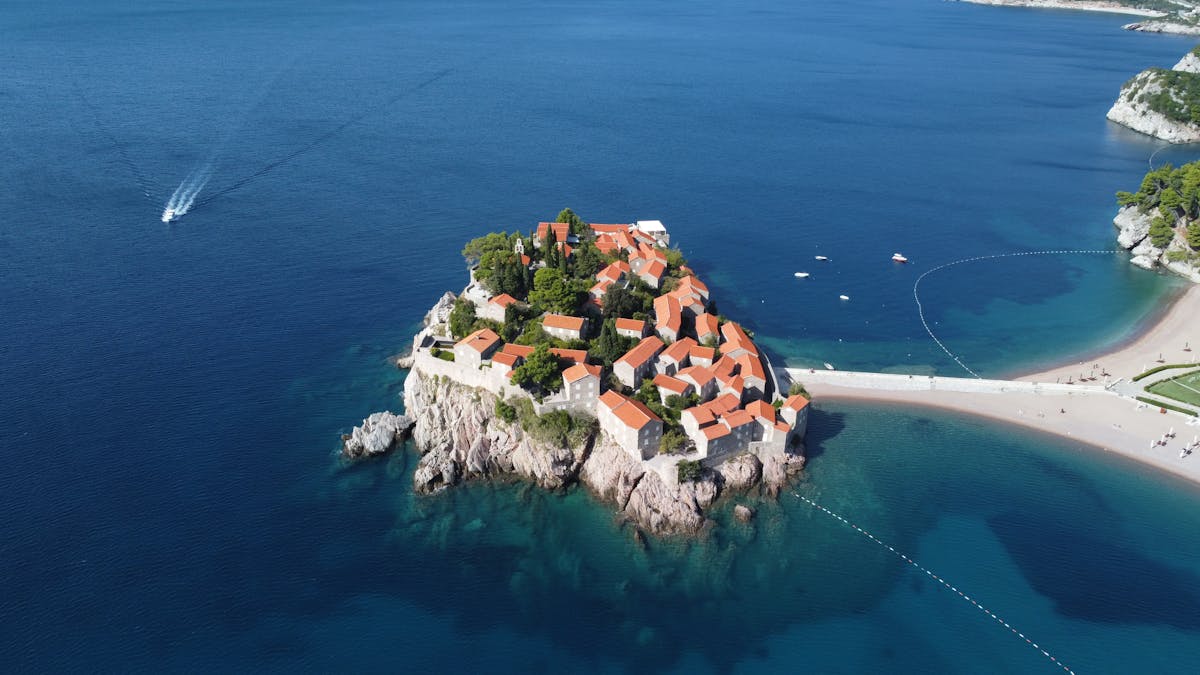
The fortified island of Sveti Stefan, connected to the mainland by a narrow causeway, is the single most photographed view in Montenegro. The island itself is a private Aman resort — you cannot walk onto it without a hotel booking — but the view from the mainland is the main attraction and costs nothing.
The public beaches on either side of the causeway offer excellent swimming with the island as a backdrop. The northern beach is the more accessible of the two. The southern side — Queen's Beach (Kraljičina Plaža) — has finer sand and is slightly less crowded, but requires walking down a steep path.
The viewing point from the road above gives the classic postcard angle. A small car park at the top charges €2–3 in summer. Several restaurants sit along the road, and the village of Przno is a five-minute walk north — worth a stop for lunch at one of the waterfront restaurants there.
How to get there: Drive, take the local bus from Budva bus station (runs every 30 minutes in summer, €1–2), or walk the coastal path from Bečići (about 45 minutes, mostly paved).

Kotor and the Bay
Distance: 25 km north of Budva (30 minutes via the Sozina tunnel, 60 minutes via the coastal road)
Kotor is a UNESCO World Heritage town set at the innermost point of the Bay of Kotor — a fjord-like inlet surrounded by mountains that rise almost vertically from the water. The Old Town is enclosed within medieval walls and has a density of churches, palazzos, and squares that rivals anything on the Adriatic.
The main draw beyond the Old Town itself is the climb to the fortress of San Giovanni. The route is 1,350 steps cut into the mountainside behind the town, rising 260 metres with increasingly dramatic views at every turn. Allow 45–90 minutes for the ascent depending on fitness and heat. Bring water — there is no shade on the upper sections and in summer the stone radiates heat.
Inside the Old Town, the Cathedral of St. Tryphon (built 1166) and the Maritime Museum are the key sights. The squares — Trg od Oružja, Trg od Brašna — are small but atmospheric, lined with restaurants and cafés.
Combine with Perast: The village of Perast sits 12 km before Kotor on the bay road. From here, a water taxi (€5 return) takes you to Our Lady of the Rocks — a tiny man-made island supporting a church filled with votive paintings. The island and the bay views from Perast are exceptional. Budget 1–2 hours for Perast before continuing to Kotor.
How to get there: Rental car is the most flexible option. The coastal road through Tivat and around the bay is more scenic but takes twice as long as the Sozina tunnel route. Organised tours run daily from Budva from around €25–35 per person. The local bus runs to Kotor several times daily (€4–5, about one hour).
Lovćen National Park
Distance: 60 km from Budva (90 minutes by car)
The winding road from the coast up to Lovćen summit is one of the best drives in the Balkans — 25 hairpin turns climbing from sea level to over 1,600 metres with views that expand at every bend. The destination is the Njegos Mausoleum at the top of Mount Jezerski Vrh (1,657 metres), a monument to the 19th-century poet and ruler Petar II Petrović-Njegos.
From the car park, 461 steps carved into the rock lead up to the mausoleum entrance. Inside is a granite statue of Njegos and a crypt below. The viewing terrace outside offers a panorama that extends across Montenegro, the bay, and on clear days across the Adriatic to the Italian coast.
The national park itself covers 6,220 hectares of mountain terrain with hiking trails, forests, and the historic village of Njeguši — birthplace of the country's most famous pršut (cured ham) and cheese. Several family homes in Njeguši sell pršut, cheese, and honey directly, and a couple of small restaurants serve traditional mountain food. A stop here is worth 30–45 minutes.
How to get there: Rental car or organised tour. There is no public bus to the summit. The road is well-surfaced but narrow with tight bends — drive carefully and allow the full 90 minutes. Most tour operators combine Lovćen with Cetinje (see below) in a single-day itinerary.

Cetinje
Distance: 30 km from Budva (40 minutes by car)
Cetinje served as Montenegro's royal capital from the 15th century until 1946 and retains the quiet grandeur of a small European court town. Tree-lined boulevards connect former embassies, royal palaces, and monastery buildings — all modest in scale but full of history.
The main sights are the Cetinje Monastery (housing relics including what is claimed to be the right hand of St. John the Baptist), the National Museum of Montenegro (spread across several buildings), and the former King Nikola's Palace. The town is small enough to walk in an hour or two.
Cetinje pairs naturally with Lovćen — the road from the national park descends directly into town. A combined Lovćen-Cetinje day trip takes 6–8 hours from Budva and covers both the mountain scenery and the cultural history.
How to get there: Rental car, organised tour, or the local bus from Budva (runs several times daily, €3–4, about 40 minutes).
Skadar Lake
Distance: 60 km from Budva (70 minutes by car)
Montenegro's largest lake — and the largest in the Balkans — straddles the border with Albania and is home to over 260 bird species including Dalmatian pelicans. The landscape is flat, green, and utterly different from the coast. If you have been beach-hopping for days, the change of scenery alone is worth the drive.
The standard experience is a boat tour from the village of Virpazar, lasting 2–3 hours and covering the water lily fields, island monasteries, and bird nesting areas. Boats carry 10–15 passengers and depart several times daily in summer (€10–15 per person). Private boats are also available.
The Crmnica wine region surrounds the lake's southern shore. Several family vineyards offer Vranac tastings and sell directly. Combining a boat tour with a vineyard visit makes for a full day. Lunch at one of the lakeside restaurants in Virpazar or Rijeka Crnojevića (a village 15 minutes further) completes the trip.
How to get there: Rental car is the easiest option — the drive is on the main highway and mostly flat. Organised tours from Budva typically cost €30–45 per person including the boat ride. No direct public bus connects Budva to Virpazar, though you can reach it via Podgorica with a transfer.
Petrovac and the Southern Coast
Distance: 17 km south of Budva (25 minutes by car)
Petrovac is a small coastal town with a red-sand beach, a Venetian fortress, and a quieter atmosphere than Budva. It is worth a half-day trip if you want a break from the main Riviera crowds. The town has a handful of good restaurants along the waterfront and two tiny island fortifications visible from the beach — Katič and Sveta Nedjelja.
From Petrovac, the road continues south to Buljarica Bay — a long, undeveloped beach backed by olive groves and wetland. It is one of the wildest stretches of coast in Montenegro and sees very few visitors compared to the Budva beaches.
How to get there: Rental car, taxi (€15–20 from Budva), or the local bus which runs along the coast road.
Getting Around
Rental car is the most flexible option and recommended for Lovćen, Skadar Lake, and the southern coast. Roads are generally well-surfaced but narrow on mountain routes. Fuel is slightly cheaper than Western Europe. Parking in Kotor Old Town and Budva can be difficult in summer — arrive early.
Organised tours run daily from Budva to all major destinations, bookable through hotels, the tourist information office near the marina, or online. Typical prices are €25–45 per person depending on the destination and group size.
Local buses are cheap and reliable for Kotor, Cetinje, and the coastal towns. The Budva bus station is on the main road behind Slovenska Beach. Timetables are available at the station and online.
Boat trips along the coast depart from the Budva marina throughout summer, covering Sveti Stefan, the beaches south of town, and occasionally the Bay of Kotor. These are half-day or full-day excursions with swimming stops.
Browse our full activities & tours listings for operators, schedules, and booking details.